
Violence
Last week Monday we were startled by messages about violence in the Djugu area, about 70 km north of Bunia. Armed rebel groups went mad with swords and machetes, killing over 30 people.
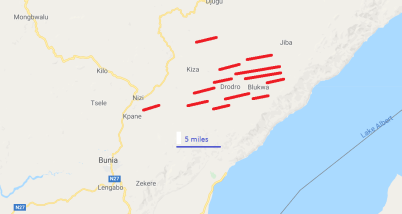
- Places where the violence took place
Houses are being destroyed by fires, forcing hundreds of people to flee in a panic. Some seek refuge in Bunia and arrive with nothing but the clothes they have on. Others have crossed lake Albert to find help in Uganda.
Displaced people
Some of them were taken in by family members or church host families whilst others gather around the central hospital. There is a huge number of children among them, some of whom are without parents or guardians. Last Tuesday there were around 600 displaced people at the hospital, but the crowd slowly reduces as more and more people find a host. It is estimated that the total number of displaced people in the city right now is around 10 000.


Roelof went to the hospital Tuesday, to check out the situation. The hospital pastor coordinates the situation and keeps track of the need and the numbers. Doctors without borders have taken responsibility for the medical need, whilst Samaritan’s Purse (SP) and local churches offer support. Roelof developed an agricultural credit system with SP in the Bunia region last year and received maize and beans as a reimbursement. Out of these reimbursements SP was able to donate two huge bags of maize and a bag of beans. The UN is doing research to map out the situation.
On Monday and Tuesday, Bunia was declared ‘Ville morte’ (dead city) which means all commercial activity was put on hold. Unknowingly, we went to work as usual, and were excited to deliver the first Safe Haven Project workshop, aimed at church leaders. On the way to work, I noticed the market was completely deserted, but thought nothing of it. I got suspicious when all shops remained closed in the afternoon. The safety department of SP had decided that Ruby (intern) and I would be safest outside of Bunia and had to evacuate that very moment.
We went to Nyankunde, where we stayed for two nights. There we had a special encounter with an Irish missionary, who has lived through many Congolese wars. She was shot in her shoulder two years ago by a rebel, which the government recognised by giving her a certificate of bravery.


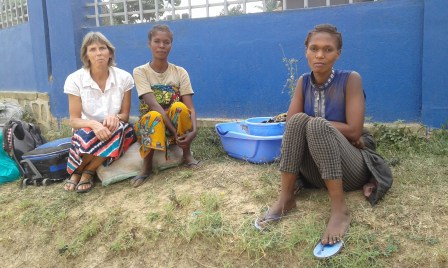
All commercial activity was resumed on Wednesday, when we returned to Bunia. All week, displaced people came flooding into the city, now fleeing ahead of time, out of fear. These people are better prepared, and come with mattresses, bags, food, etc. I met two ladies on the side of the highway on Friday. They came from Mongwalu and looked completely worn down and covered in dust. ‘Have you got any family?’ None! ‘Food?’ Nothing! I gave them some money and consequently, other people stopped and gave money as well. I then prayed with them and referred them to the central hospital.
Generally, there is a lot of fear in Congo. The last war was in 2004, and very much alive in people’s memories. Nobody knows what will happen next. The churches are praying, and the local chiefs are calling for peace. We also pray this does not escalate any further and that all the displaced people are able to return to their home.
 Terug naar Congo