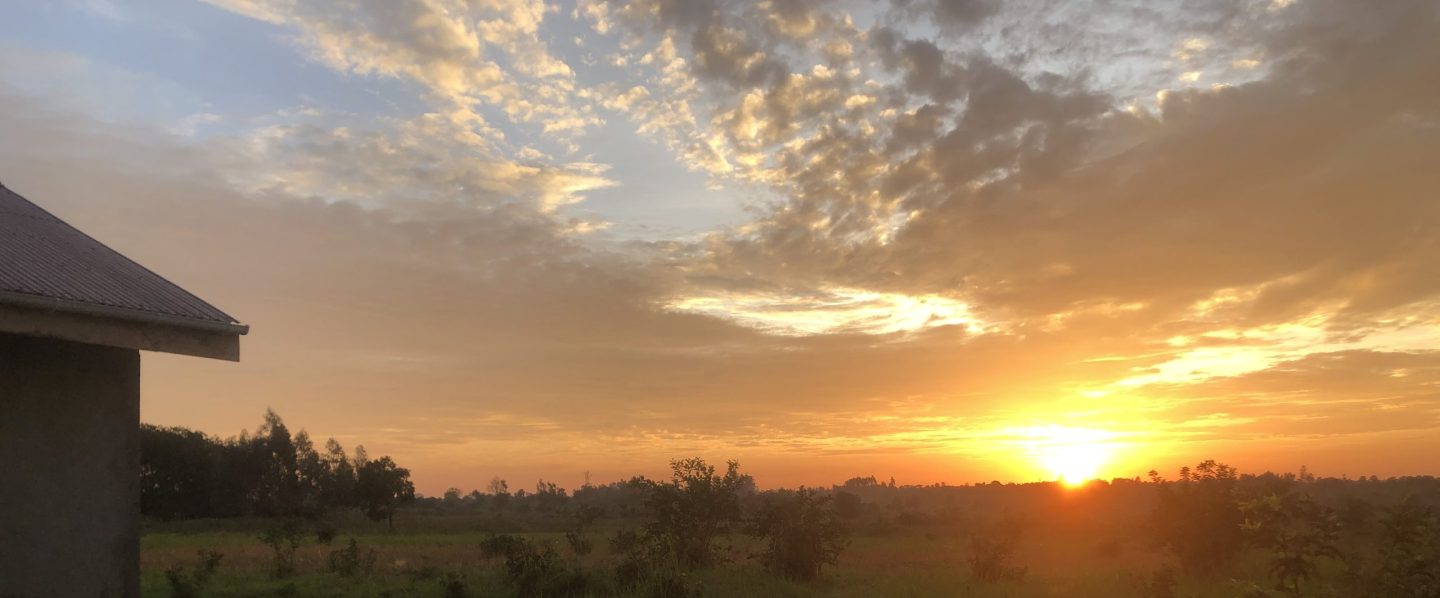

Since March this year, Roelof and I have been living in Amanipi, a small village located in the far northeastern corner of the Democratic Republic of Congo. It’s close to Uganda, just 40 kilometers from the Sudanese border, and lies on the edge of the Lugbara people’s territory. A major road connects the border to larger cities in Congo, and Amanipi is situated about three kilometers from this main road.


But what exactly is Amanipi? At first glance, the village appears modest — just an Evangelical church and two simple brick houses with corrugated iron roofs. As we explore further, we discover that Amanipi extends over several square kilometers of savannah, with homes scattered across the landscape. There’s even a small center with a Catholic church and school. Finding the people, however, requires some effort. You really have to venture out to meet them.
A Stroll Around the Village
I take a short walk around the area, starting from our house. It’s a pleasure to greet the neighbors and get to know them better. A narrow path leads about 50 meters toward the church grounds. Turning right takes me to the church, but I turn left toward the pastor’s house. He and his visitor are sitting outside and greet me warmly in Lugbarati, and I respond in kind. I’ve now mastered the basics of greetings and small talk. His wife and daughter are busy in the kitchen, and the children are playing outside. The pastor smiles at me. Despite the challenging circumstances, he remains upbeat — a joy that runs deep, rooted in his faith in Jesus.


A little further, I reach another cluster of homes, built in the local style. Here, Anguezu and Sorry live with their family. I walk into their yard, where there is always a lively atmosphere, usually filled with small children. As soon as I arrive, they set up a few chairs for me. You don’t just pass through here; sitting down is part of the Congolese hospitality. You always feel welcomed, and it’s a heartwarming experience. I sit down, and Sorry and I chat for a while before I continue my walk.


Next, I visit Alio and Ayikuru’s home, a family with five children. Alio is busy repairing his old motorcycle. He’s taken the engine apart and is patiently reassembling it. I watch in awe — his tools are minimal, yet he handles the work with ease. Alio is very skilled and often helps us with various tasks around the house.

Daily Life
On the compound, cassava is drying after being soaked in water. Once dried, it can be stored for a long time. The people here make fufu from cassava, a staple food they absolutely love.
Ayikuru is also there with her two youngest children, Manzedri and Jeremy. The children are quite shy around me, often hiding behind their mother. Ayikuru helps me three mornings a week with household tasks: handwashing clothes, cleaning the house, and baking bread. I’m incredibly grateful for her assistance — without her, I’d be doing everything myself, as all the work here is done by hand.


Together, we inspect the peanut field Ayikuru has planted using the 4Pillar method, which doesn’t require plowing. She’s delighted with the method as it saves her time and money and is much less physically demanding. While we chat, the neighbor’s children climb a palm tree to pick oil palm fruit. I ask, “Are you making palm oil?” (That’s what they used to do in Lanza). “No,” they reply, “we don’t have enough fruit for oil, we just eat them, they’re delicious!”
Market Day
On Wednesdays, there’s a market in Orya, a village four kilometers away. Ayikuru and I cycle there together. Along the way, we encounter various acquaintances and stop for quick chats. We pass through the center of Amanipi, where there are motorcycle repair shops, and where gasoline and spirits are sold. In the evenings, loud music often blasts from large speakers. The first people we see are Alio and Anguezu, who are attending a meeting at the center. Next, we encounter a pastor from the Evangelical church who is selling gasoline.


We finally reach the market, which is buzzing with the vibrant colors and energy that Congo is known for. Goods are laid out directly on the ground, with women sitting on small stools beside them. Peanuts, freshly harvested, are in abundance, and the entire market is filled with them, selling for a pittance.


I’m only looking for some vegetables and fruit. There’s plenty of cabbage. For just 13 cents, I buy a cabbage and a papaya — truly inexpensive! It’s clear that the vendors’ earnings are minimal.
A “mundú” (white person) at the market is quite the spectacle! I’m stared at from all sides. Many women and children seem shy and look at me with some suspicion. I definitely feel like an outsider. Thankfully, I can now speak a bit of Lugbarati, and greeting people in their own language often helps break the ice. A few older men greet me in French, perhaps to impress me.


After looking around, we head back to our bikes. One of the bike repairmen adds some air to my tire, and then we begin the ride home. I feel fortunate to have a comfortable mountain bike. I think about all the women who must walk this distance or further, carrying heavy loads on their heads. I feel deeply blessed to live and work among these people, but I also recognize that there is still a long way to go before the community can escape poverty